Vibration analysis in machine bases
This article describes the analysis of vibrations in machine bases, namely the DMC criteria for chassis and respective masses.
Focuses on rigid machine bases. Those supported on anti-vibration supports are not mentioned., whose topic is treated in an article on vibration isolation.
Problems with machine bases and fixing are common, especially on alternative machines, but are little focused on in the literature on vibration analysis of rotating machines.
In particular, there is no ISO criterion for vibration levels at its bases. Effectively all existing criteria in ISO standards, for rotating machines, are for measurements carried out on bearings.
Functions of a machine base
The support structure (base/countertop) of a machine, for example, a horizontal shaft motor pump group — which supports the electric motor and pump, usually connected by a coupling — performs several essential functions:
a) Structural support and load distribution
- Supports the weight of the motor and pump, distributing these loads evenly to the foundation.
- Absorbs static and dynamic efforts generated during operation (own weight, engine torque, hydraulic reactions).
b) Alignment maintenance
- Ensures and preserves correct alignment between motor shaft and pump shaft, essential to avoid premature wear of the coupling, bearings and packings/mechanical seals.
- Provides enough rigidity so that this alignment does not degrade with vibrations, thermal expansions or start/stop efforts.
c) Vibration damping and control
- Reduces the transmission of vibrations to the floor/foundation and to the assembly itself, contributing to smooth and quiet operation.
- In many cases it incorporates or allows the installation of anti-vibration supports.
d) Fixing to the foundation
- Has holes or anchors (fixing screws) to anchor the assembly to the foundation mass, ensuring stability and avoiding displacement during operation.
e) Dimensional and leveling reference
- Ensures correct leveling of the assembly, essential for the correct functioning of the bearings and to avoid asymmetrical loads.
- Maintains the correct dimensions in relation to suction and compression pipes.
f) Ease of maintenance
- Allows access and disassembly/replacement of components (motor, bomb, coupling) without the need for foundation interventions.
- On common metal bases, allows realignment through shims and adjustment screws.
g) Protection and containment
- In some solutions, the base includes a basin or rim for collecting oil spills, grease or water, avoiding pavement contamination.
- It also contributes to protection against corrosion (painted bases, galvanized or concrete).
h) Accessory support
- Serves as support for complementary elements such as the coupling guard (security protection), pipe supports, or nameplates.
For the base to fully perform these functions, It is essential that it is sufficiently rigid in relation to the bearing system of the machine it supports — a concept that is detailed below.
What is a Rigid Machine Base
The Norma API 541 – Form-Wound Squirrel-Cage Induction Motors — 375 kW (500 Horsepower) and Larger, is referred (in free translation):
“The stiffness of a foundation is a relative quantity. It must be compared with the rigidity of the machine's bearing system. The ratio between bearing vibration and foundation vibration is a characteristic quantity for evaluating the influences of foundation flexibility.. An indication that a foundation is massive is if the vibration amplitudes of the foundation (in any direction) near the machine feet or base structure are less than 30% of the amplitudes that could be measured in the adjacent bearing in any direction.”
This statement, applied to electric motors, is also valid for other horizontal shaft rotary machines.
DMC assessment criteria for vibration levels in rigid bases of rotating machines
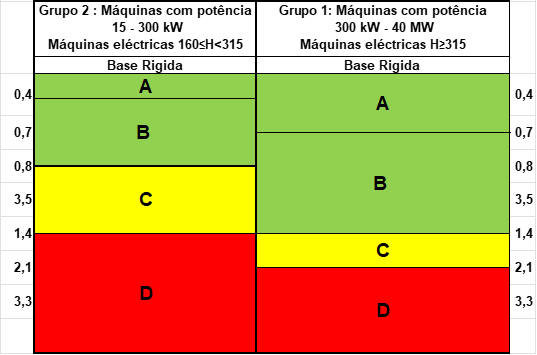
Taking into account the aforementioned criteria, that the level of vibrations in the base must not exceed one third of that measured in the bearing, the vibration assessment criteria defined in ISO can be used 20816 and build a vibration assessment criterion on a machine basis. As in ISO 20816, The values shown correspond to the RMS vibration speed (effective value).
According to this DMC criterion, the values are equal to 30% as defined in the various ISO standards.
Therefore, for machines covered by ISO 20816-3, the following criterion would be.
Remember that, at the ISO convention 20816, the A/B borders, B/C and C/D delimit increasing assessment zones: zone A corresponds to new machines, zone B to values considered acceptable for long-term operation without restrictions, zone C to levels that restrict short-term operation (recommending corrective action) and zone D at values considered sufficient to cause damage to the machine.
Table 1 – Proposal for limits of the assessment zone for vibration on machine bases within the scope of ISO 20816-3 (mm/s)
Acceptable vibration levels on the basis of an alternative machine
In the ISO standard 20816-8 – Mechanical vibrations — Measurement and evaluation of machine vibrations — Part 8: Alternative compressor systems, vibration limits are mentioned for machine fixing points.

| 1 – Positions of the compressor structure fixing screws |
Figure 1 – Diagram of measurement points on a vertical reciprocating compressor
In this standard, for this type of machine, The limits are defined and can be seen in the table below.
Table 2 – Limits of the vibration assessment zone for Vertical Compressors, V e em W (mm/s)
| Compressor | Vibration Speed (mm/s) | ||
| A/B | B/C | C/D | |
| Foundations | 2,0 | 3,0 | 4,5 |
| Structure | 5,3 | 8,0 | 12,0 |
The vibration values indicated in the Tables 2 apply to compressor systems mounted on rigid foundations. This means that the compressor and drive motor are mounted directly on the concrete foundations. If the compressor and drive motor are mounted on a chassis, it must be sufficiently rigid and be mounted directly on the concrete foundations.
Vibration analysis in machine bases – a fase
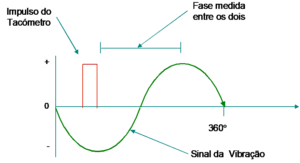
Below you can see a video about the application of phase analysis to check for loosening.
Vibration analysis in machine bases – Example
At the request of a manufacturing unit, a, common vibration analyzer, a diagnosis by Vibration Analysis on one reciprocating compressor, ammonia from a food industry, which had excessive vibrations. In the photo below you can see the machine in question..

Figure 2 – Ammonia compressor
The results of the measurements carried out can be seen in the diagram., in the vertical direction, in the support structure.

Figure 3 – Results of measurements at measurement points in the group support structure, in the vertical direction.
Note how the measurements on the side of the belts have values greater than the opposite side and also greater than the limits defined in the Table 2.
This asymmetry of values led to the suspicion that there was a loosening of the structure on the belt side..
After a visual inspection, this was confirmed as seen in the film below..
Vibration analysis in machine bases – Conclusion
In the absence of a specific ISO criterion for vibrations measured in rotating machine bases, the DMC criterion — obtained from the relationship of 1/3 between the vibration in the base and the vibration in the bearing, referred to in the API 541 — allows you to establish practicable assessment limits, applicable based on the criteria already defined in ISO 20816. The case study reinforces the importance of including the support structure in vibration analysis programs for rotating machines.
References
API 541 – Form-Wound Squirrel-Cage Induction Motors — 375 kW (500 Horsepower) and Larger.
ISO 20816-3:2022 – Mechanical vibration — Measurement and evaluation of machine vibration — Part 3: Industrial machines with power ratings above 15 kW and rated speeds between 120 r/min and 30 000 rpm.
ISO 20816-8 – Mechanical vibration — Measurement and evaluation of machine vibration — Part 8: Reciprocating compressor systems.