Displacement Measurements, Speed or Acceleration
This article explains why measurements are carried out in displacement, speed or acceleration as part of a vibration monitoring in predictive maintenance. Throughout the text we see how the choice depends on the frequency of the phenomenon, the type of defect and the physical degradation mechanism involved.
The choice between measurements in displacement, velocity or acceleration is not arbitrary. It results from the way in which each of these quantities relates to the vibration frequency and with the physical mechanism responsible for machine degradation.
The three quantities describe exactly the same vibratory movement, but emphasize different frequency ranges and different mechanical effects.
1. Physical relationship between displacement, velocity and acceleration
These quantities are linked by temporal derivatives:
- Speed = derivative of displacement
- Acceleration = derivative of speed
For a sinusoidal vibration:
- displacement: x(t) = X·sin(ωt)
Deriving in order of time, instantaneous speed and acceleration are obtained:
- v(t) = dx/dt = Xω·cos(ωt) → peak amplitude: V = Xω
- a(t) = dv/dt = −Xω2·sin(ωt) → peak amplitude: A = Xω2
That is, the peak amplitudes of each quantity are:
- velocity: V = Xω
- Acceleration: A = Xω2
at where:
- X = displacement (peak amplitude)
- V = speed (peak amplitude)
- A = acceleration (peak amplitude)
- ω = 2πf, where f is the frequency (in Hz)
This results in a fundamental fact:
- speed increases proportionally to frequency;
- acceleration increases with the square of frequency.
Like this, the same vibration may appear small in displacement and very large in acceleration if it occurs at high frequency.
2. The most important factor: the frequency of the phenomenon
Low frequencies
(< 10–20 Hz)
The physical movement of the machine predominates.
It is more appropriate to measure:
- displacement
Examples:
- imbalance of large rotors;
- structural oscillations;
- building vibration;
- hydraulic turbines.
Average frequencies
(10–1000 Hz approximately)
The energy transmitted to the structure is best represented by the velocity.
That is why it is used:
- RMS speed
It is the parameter adopted by ISO standards to evaluate the severity of vibration.
Examples:
- engines;
- bombs;
- fans;
- reducers;
- compressors.
High frequencies
(>1000 Hz)
Displacement amplitudes become extremely small.
However, acceleration grows quickly.
Like this, measure:
- acceleration
Examples:
- bearing defects;
- impacts;
- cavitation;
- gears;
- cracks;
- shocks.
3. The degradation mechanism
The choice also depends on the type of failure.
| Type of defect | Preferred magnitude | Justification |
| Imbalance | Displacement or speed | Large rotor movement |
| Misalignment | velocity | High vibratory energy |
| Days off | Speed and acceleration | Movement + impacts |
| bearings | Acceleration | High frequency impacts |
| gears | Acceleration | High frequencies |
| cavitation | Acceleration | hydraulic shocks |
| Shafts in hydrodynamic bearings | displacement | Relative shaft movement |
4. Relationship with mechanical damage
Each quantity is related to a different type of effort.
displacement
Relates to:
- relative motion;
- days off;
- interference;
- contact between components.
Question that answers:
How much the machine moves?
velocity
Relates to:
- vibratory energy;
- transmitted power;
- structural fatigue.
Question that answers:
How much vibratory energy is being transmitted?
That is why it is used by ISO 20816.
Acceleration
Relates to:
- dynamic forces.
By Newton's second law,
F = m · a
greater acceleration implies greater inertia forces.
Question that answers:
What instantaneous forces are acting on the machine?
It is therefore particularly sensitive to impacts and incipient defects.
5. Frequency sensitivity
Consider a constant displacement vibration.
As the frequency increases:
| Frequency | displacement | velocity | Acceleration |
| 10 Hz | high | reduced | very reduced |
| 100 Hz | equal | 10× largest | 100× largest |
| 1000 Hz | equal | 100× largest | 10 000× largest |
Consequently:
- offset “favors” low frequencies;
- speed is approximately balanced over a wide range of frequencies;
- acceleration highlights high frequencies.

Figure 1 – Displacement, speed and acceleration as a function of frequency, for a constant displacement amplitude (log-log scale). Velocity increases proportionally to f and acceleration to f², confirming the behavior described in the table above.
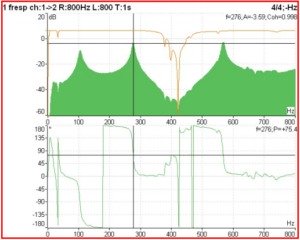
Next you can see the vibration in displacement, speed and acceleration in a real machine.
6. Why speed is used in ISO standards?
Speed constitutes a compromise between displacement and acceleration.
- Does not overvalue low frequencies;
- Does not overvalue high frequencies;
- Correlates well with vibrational energy;
- Correlates well with structural damage in many industrial machines.
Therefore, Most severity assessment standards use mm/s RMS.
7. Because to detect damage to bearings they use acceleration?
When a small defect appears on a raceway:
- the displacement produced may be less than 0,1 μm;
- the speed remains very low;
- but the impact generates accelerations of hundreds of g for a few microseconds.
Acceleration allows you to detect these defects long before they are visible in speed or displacement.
8. Because to API 670 uses displacement?
In turbomachines supported on hydrodynamic bearings, it is important to know the movement of the shaft in relation to the bearing.
The critical parameter is:
- the orbit of the shaft;
- the available slack;
- the possibility of contact between the shaft and the bearing.
In these cases, the displacement is measured with proximity probes, normally in μm peak-to-peak.
9. resume
| Greatness | Better frequency range | Phenomena that evidence | Typical Applications |
| displacement (μm) | Low frequencies | Physical movement and excursion of the rotor | turbines, hydrodynamic bearings, large rotors, orbit analysis |
| velocity (mm/s RMS) | Average frequencies | Vibrational energy and global severity | engines, bombs, fans, reducers, monitoring according to ISO 20816 |
| Acceleration (m/s² or g) | High frequencies | Dynamic forces, impacts and incipient defects | bearings, gears, cavitation, shocks and early diagnosis |
10. Displacement Measurements, Speed or Acceleration – Conclusion
Selecting between displacement, speed and acceleration essentially depends on four factors:
- The frequency range of the vibratory phenomenon;
- The type of defect that is intended to identify;
- The physical mechanism of degradation (movement, energy or strength);
- The purpose of measurement, whether general monitoring, detailed diagnosis or machine protection.
It is for this reason that modern vibration monitoring and analysis systems often record all three quantities simultaneously., using digital integration or differentiation of the accelerometer signal, to provide the most appropriate information for each type of analysis.
In practice, most of data collectors and analyzers directly measures acceleration with an accelerometer and obtains speed by digital integration of the signal, and displacement by double integration. This process works well, but requires some care: integration amplifies low-frequency noise, therefore it is necessary to apply high-pass filters (high-pass) suitable to avoid drifts (drift) and distortions in the calculated displacement and speed values.
11. References
- ISO 20816-1:2016 – Mechanical vibration — Measurement and evaluation of machine vibration — Part 1: General guidelines.
- ISO 20816-3:2022 – Mechanical vibration — Measurement and evaluation of machine vibration — Part 3: Industrial machines with a power rating above 15 kW and operating speeds between 120 r/min and 30 000 rpm.
- ISO 20816-9:2020 – Mechanical vibration — Measurement and evaluation of machine vibration — Part 9: Gearboxes.
- API Standard 670, 5th Edition – Machinery Protection Systems, American Petroleum Institute.
- ISO 13373-1 – Condition monitoring and diagnostics of machines — Vibration condition monitoring — Part 1: General procedures.