Motion analysis concepts
This article describes the various concepts of motion analysis.
The vibratory behavior of a mechanical system can be classified according to the origin of the force that causes vibration and how the response evolves over time.. Among the most important concepts are free vibration, damped free vibration, the self-excited vibration, steady-state vibration and transient vibration. Also very important is the concept of degrees of freedom.
1 Free vibration
Free vibration occurs when a system is initially disturbed from its equilibrium position and, after this initial disturbance, is not subject to any external force again. The energy required for vibration is supplied only by the initial impulse or displacement.
In an ideal system, without any form of cushioning, mechanical energy remains constant and vibration continues indefinitely with constant amplitude and frequency equal to the natural frequency of the system.
This type of vibration is used to determine dynamic properties, like to natural frequency and the rigidity of mechanical components.

Figure 1 – The movement of the pendulum is an example of a free oscillation. If there was no damping, would never stop
2 Damped free vibration
In practice, All systems have some energy dissipation mechanism, due to friction, air resistance, structural damping or viscous damping. In these cases, damped free vibration occurs.
Just like in free vibration, the system receives only an initial disturbance, there is no subsequent external excitation. Yet, part of the vibratory energy is continually dissipated, causing the amplitude to progressively decrease until the movement completely ceases.
The vibration frequency remains very close to the natural frequency, although it is slightly lower when there is significant damping. How quickly the amplitude decreases depends on the system's damping coefficient..
This behavior is often observed when a machine is subjected to an impact or when it is turned off and continues to vibrate for a few seconds..

Figure 2 – Example of a damped free movement
3 Self-excited vibration
In self-excited vibration, the energy required to maintain vibration does not come from a periodic externally applied force, but rather from the system's own energy source. An internal mechanism continually transfers energy to vibration, compensating for damping losses.
Unlike forced vibration, the oscillation frequency is normally determined by the dynamic characteristics of the system and not by the frequency of an external excitation.
The amplitude initially increases until reaching an equilibrium value, where the energy supplied is equal to the energy dissipated.
Typical examples of this phenomenon are:
- Oil Whirl e Oil Whip on machines with hydrodynamic bearings;
- friction vibrations (“stick-slip”);
- aeroelastic instabilities;
- tool vibration during machining processes (chatter);
- phenomena of surge compressors.
Self-excited vibrations are often undesirable, which can cause accelerated wear, structural fatigue or even catastrophic failures.
4 Steady-state vibration
It is called steady-state vibration (or permanent regime) the system response after all transient effects disappear.
In this regime, vibration presents practically constant characteristics over time, as amplitude, frequency and phase. If the excitation is periodic, the steady state response will also be periodic, occurring normally at the excitation frequency.
On rotating machines in continuous operation, most of the vibration measurements performed for predictive maintenance corresponds precisely to the steady state, since it is in this condition that stable and repeatable vibration spectra.
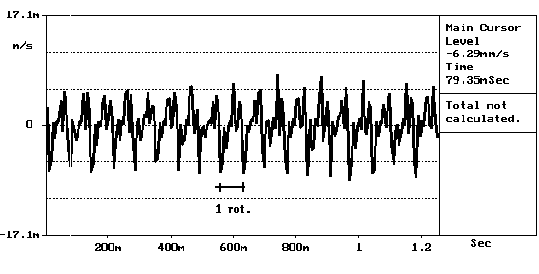
Figure 3 – Example of stationary vibration measured in the bearing of a rotating machine
5 Transient vibration
Transient vibration corresponds to the temporary response of the system during the transition between two operating states.
This type of vibration appears whenever there is a sudden change in system conditions., for example:
- starting a machine;
- stop;
- mechanical impact;
- rapid opening or closing of valves;
- sudden variation in rotation speed;
- occurrence of a failure.
During the transitional regime, amplitude and frequency can vary significantly over time, reflecting the interaction between the natural response of the system and the forces applied to it.
After a sufficiently long time interval, the transient component disappears due to damping, remaining only the steady state response, if there is continuous excitation.

Figure 4 – Example of transient vibration measured in a fan bearing during its stop.
6 Comparison between different vibration regimes
| Type of vibration | Origin of energy | Continuous excitement | Amplitude |
| Free vibration | Initial disturbance | No | Constant (ideal) |
| Damped free vibration | Initial disturbance | No | Decreases to zero |
| Self-excited vibration | Internal energy of the system | Sim (internal mechanism) | It grows until it reaches an equilibrium value |
| Transient vibration | Sudden change of conditions | It may exist | Varies over time |
| Steady-state vibration | Continuous excitement | Sim | Approximately constant |
In vibration engineering, These five concepts constitute the basis for interpreting the dynamic behavior of machines and structures. The distinction between them allows us to identify the origin of the observed vibrations, select appropriate analysis methods and establish effective fault diagnosis and control strategies.
7 Movement with one degree of freedom
One movement with one degree of freedom is one that can be completely described by a single independent variable - i.e, just a number (a generalized coordinate) to specify the position of the system at any instant.
Classic examples
- Simple pendulum — the position of the mass is completely defined by the angle θ that the wire makes with the vertical.
- Block sliding in a straight chute — just needs the x coordinate along the gutter.
- Piston in a cylinder — the linear displacement of the piston is the only variable.
Why does it matter??
The number of degrees of freedom determines how many equations of motion are needed to describe the system. With just one degree of freedom, the analysis is simplified to a single differential equation, which makes these systems ideal for introducing concepts of dynamics and vibrations.
8 Motion with multiple degrees of freedom
One movement with multiple degrees of freedom is the one who demands more than one independent variable to fully describe the system configuration. Each degree of freedom corresponds to a generalized coordinate — and, therefore, to a proper equation of motion.
Examples
| System | Degrees of freedom | Typical coordinates |
| Double pendulum | 2 | angles θ₁ and θ₂ of each bar |
| Mass suspended by two springs in series | 2 | displacements x₁ and x₂ of each mass |
| Free rigid body in space | 6 | 3 translations (x, Y, z) + 3 rotations (roll, pitch, yaw) |
| Simplified vehicle (If the angle Fc is positive) | 3 | position (x, Y) + orientation ψ |
Practical implications
- Coupling — degrees of freedom are often interconnected: movement in one coordinate influences the others, generating systems of coupled differential equations.
- vibration modes — in linear systems, it is possible to decouple the equations through a modal transformation, obtaining independent normal modes (each equivalent to an oscillator 1 degree of freedom).
- Increasing complexity — the more degrees of freedom, greater the analytical or computational effort to solve the system.
In short: If a degree of freedom needs an equation, n degrees of freedom need n equations — and the dynamics become proportionally richer (and more difficult to analyze).