Lubrication monitoring
This article deals with lubrication monitoring. The effects of excess lubricant and how to avoid it are explained.
Main problems resulting from excess lubrication
O excess lubricant in a bearing bearing It's a common mistake and can cause a number of serious problems.. Many people think that “the more, better", but with bearings the opposite happens. The main effects are:

overstretching
- The bearing becomes shake off excess lubricant (It is made churning).
- This increases internal friction and temperature.
- High temperature degrades the lubricant/oil and drastically reduces service life.
Increased friction and energy consumption
- The lubricant creates rotation resistance.
- Motors need more power → higher electrical consumption.
Premature degradation of the lubricant
- The heat accelerates the lubricant oxidation.
- The lubricant loses viscosity and protective properties.
Premature bearing failure
- It can cause accelerated wear, micropitting and even crashing.
- In extreme cases, leads to bearing breakage.
Increased internal pressure
- Excess lubricant can cause pressure inside the bearing.
- This can damage seals (retainers), causing leaks.
Environmental contamination
- Leaking lubricant attracts dust and particles.
- Contaminants enter the system and make wear even worse.
Important rule of thumb
- Bearings lubricated with lubricant: normally just 30% a 50% do volume book must be filled.
- High rotation → even less lubricant.
On the field, excess lubrication in bearings/bearings It usually gives very clear signals — the trick is knowing how to “read” the behavior of the unit before it becomes a malfunction.
Practical symptoms of over-lubrication

Abnormally high temperature
- Bearing housing hot to the touch few minutes after departure.
- Temperature rises quickly after relubrication.
- Thermography shows hot spots located in the housing.
Excess lubricant = increasing heat without increasing load.
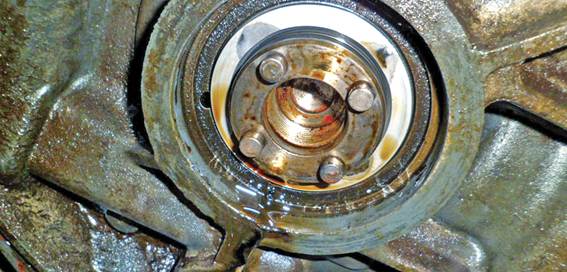
Lubricant leak
- Lubricant coming out of hair retainers or covers.
- “Ring” of lubricant around the shaft.
- Accumulation of dirt stuck to the casing.
Classic sign that internal pressure is too high.
Different noise right after lubricating
- Tinnitus, hissing or “heavy” sound when rotating.
- Noise appears immediately after lubrication, not with hours of use.
The lubricant is being tapped by the bearing (churning).
Increased energy consumption
- Engine pulls more current no load change.
- Can be seen in inverters, thermal relays or electrical analysis.
Extra friction caused by excess lubricant.
Burnt lubricant smell
- Strong odor near the bearing.
- Darkened or hardened lubricant around.
Indicates thermal degradation of the lubricant.
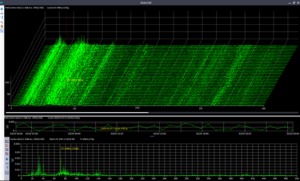
- Low frequency vibration immediately after relubrication.
- In spectral analysis, “generalized” noise increase.
Not to be confused with mechanical failure — it often disappears after removing excess.
Simple operational clues (without instruments)
- Equipment “heavy” when turning manually.
- Stuffed or displaced seals.
- Recurring failure immediately after lubrication, not before.
How to quickly confirm in the field
✔ View history: problem arose after lubricant?
✔ Measure temperature before and after relubrication
✔ Compare with identical bearing operating normally
The importance of monitoring lubrication
Best practice is not “fill until it comes out the sides”, but rather calculate the exact volume based on the bearing dimensions and define a relubrication frequency. Or use of ultrassons or vibrations during lubrication is the most modern technique, because it allows “to hear” when the bearing has reached the ideal lubricant level.
For this to happen, lubricators must be informed about the exact amount of lubricant to put in each bearing.. In fact, they are not born taught….

Below you can see the recording of the webinar on lubrication process control.